Colonial VA Head Family Genealogy
Descendants of William Head of Box Parish, Chippenham Hundred, Wiltshire Co., England and Richmond Co., Virginia
Want to Contribute?
Please join the Facebook Group
Preface
Historical Narrative
Descendant Listings
Documentary Sources
DNA Research
Acknowledgements
Preface
The surname Head ranked 962nd among the 1,000 most common names in America, according to the 1990 federal census. Many of that surname trace their origins
to the British Isles, most commonly England. As shown by the Y-chromosome DNA test results of the Head DNA Project at FamilyTreeDNA, there are many different (unrelated) families with this surname.
Still, many of the Heads in America do trace their ancestry to colonial Virginia, a significant number descended from the English immigrant William Head, who lived in the late 1600's and early 1700's in an area that
is now within King George County, along the northeast side of the Rappahannock River in Virginia's Northern Neck.
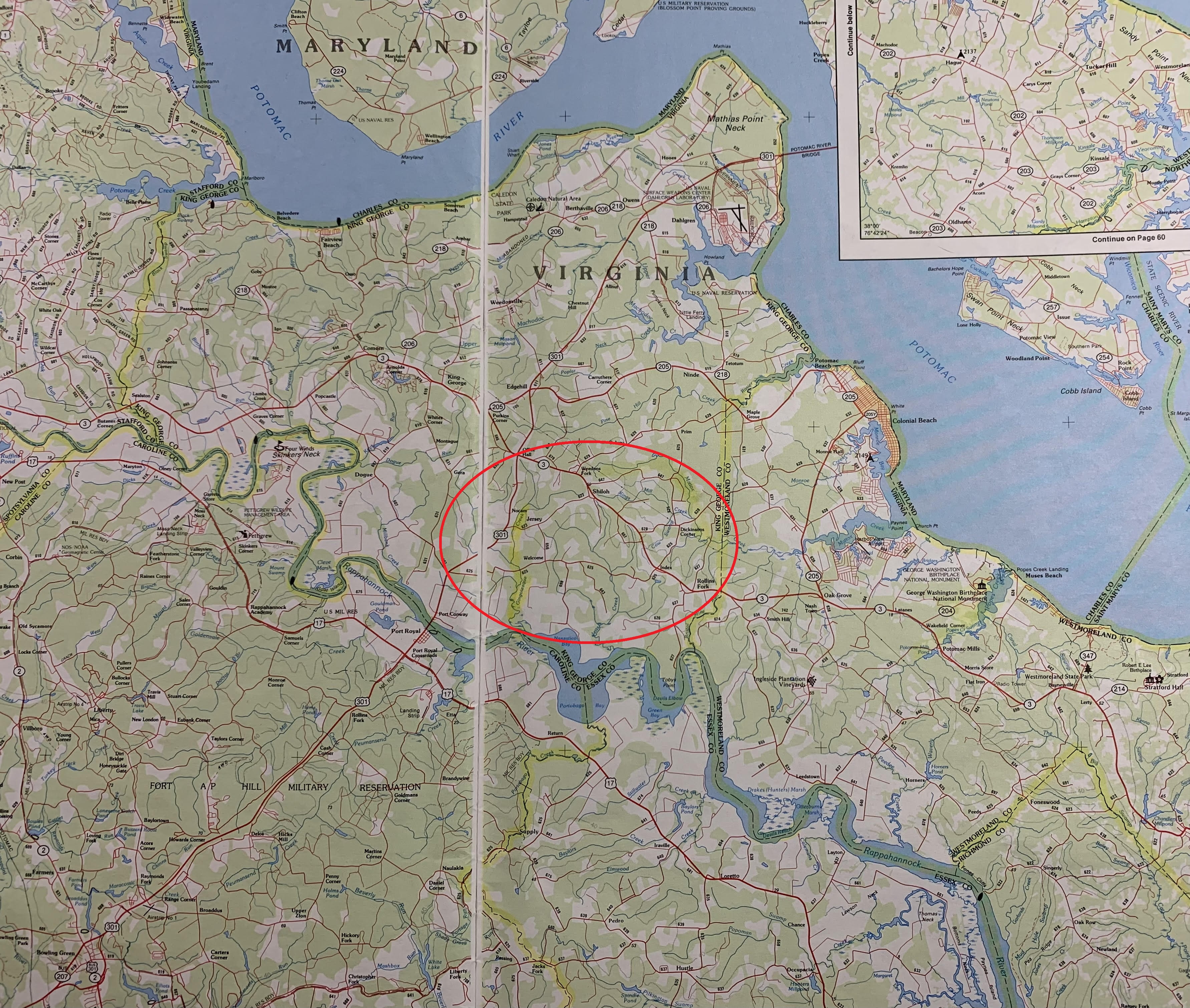
Source: DeLorme Virginia Atlas & Gazeteer (1995), pp. 70-71
Numerous family trees for this Head family have been published and posted online, but they badly conflict with one another and most of them are highly
inaccurate. The purpose of this web site is to take an evidence-based approach to genealogy (with primary documentary sources and DNA analysis) to accurately portray the relationships of the various branches of this family
of colonial Virginia, and to provide a strong evidence trail to link them back their immigrant ancestor, William Head. His place of origin in England has been determined to be Box Parish in the Chippenham Hundred of historic Wiltshire County, so
we will present the trail of evidence used to prove that connection and provide background information relating to his family in that parish. Box is located in southwestern England, east of the port of Bristol and midway between the towns of Bath and Chippenham.
As shown in Virginia's County Court Minutes and other historical records of the late 1600's and early 1700's, Bristol merchants had strong commercial interests in the Northern Neck area of Virginia.

National Library of Scotland (https://maps.nls.uk/) Map Images
In 1948, Idress (Head) Alvord compiled an impressive genealogy entitled Head - Descent of Henry Head (1695-1770) in America. Like me, Idress is descended from
Benjamin Head of Orange County, Virginia, who married Martha Sharman in the 1750's, had eight children (seven sons and one daughter), and died there in 1803. (His plantation was actually located in the part of Orange County that became Greene County
upon its formation in 1838.) Benjamin served briefly (1778-1779) as a Captain in the Orange County militia during the American Revolution, thus was often referred to as Capt. Benjamin Head by genealogists descended from him (although
I cannot find any contemporary use of that title for him, other than when he was sworn in (28 May 1778) and replaced (27 May 1779).) In her book, Idress names her ancestor Benjamin Head as a son of Henry Head (the subject of her book).
My research shows that Henry's son was a different Benjamin Head (husband of Grace, whose will was proved 15 February 1790 in Culpeper County, Virginia). (I haven't found definitive proof of the identity of our Benjamin Head's father, either, but
it wasn't Henry. I believe that Henry Head's father was the immigrant William Head, the subject of this web page.) Like many genealogists of her time, Idress speculated on the English origins of the Head family (without any evidence showing a
connection to this Head family of Virginia) and even displayed an alleged Head coat of arms on the frontispiece of her book. Idress, admittedly, did not have the benefit of DNA analysis showing that there was no single Head family, but dozens of different
ones, if not more. Attributing a coat of arms granted to someone in England in the 1660's with the Head surname to others of that surname, without supporting evidence, is not something that most modern genealogists would embrace. Most English
families outside of the gentry did not have coats of arms.
Idress's work was a good starting point for my own Head research when I started on that lineage in the 1970's. Her work was augmented by my research and that of a number of others in the last several decades.
We now have access to images of a tremendous amount of primary documentary sources, not to mention DNA findings, that she and other Head researchers didn't have easy access to until very recently, both in the US and in England.
My objective with this web page is to reexamine the work we've all done on the Heads of colonial Virginia by trying to find evidence in primary documentary sources of that time period to better construct a tree of this family
through the first five generations of descent from the immigrant William Head, from his birth in England (1642) to the early 1800's. To that end, I have abstracted hundreds of references to our Head family from the original records of colonial Virginia and
other colonies (later states) in which our Heads settled, mostly after the end of the American Revolution, especially North Carolina, South Carolina, Georgia, Tennessee, and Kentucky. Abstracts of parish registers from Box are also
included here. For example, here is William Head's baptism on 26 December 1642, showing that his father's name was Henry Head. (The handwriting of that time period is quite difficult to read, but you can accustom yourself to it
by reading page by page through historical documents, working backwards through time. Handwriting of the late 1700's in colonial Virginia is much more recognizable.)

Parish register of Box Parish, Chippenham Hundred, Wiltshire County, England
William Head (the immigrant) and many of his sons and grandsons died intestate (leaving no wills). No family Bibles are known to exist for those first few generations. Vital records (as we know them today) did not exist until later.
And where are records relating to daughters and grandddaughters of William Head? (Surely he had some.) Therefore, it is quite a challenge to find solid proof of the relationships between the various Heads living in colonial Virginia through the middle 1700's.
The good news is that there only appears to have been this one Head family (William's) living at that time in Virginia's Northern Neck counties and the newer counties just to their west that were formed in the late 1600's and early 1700's.
Based on that and the modern DNA evidence, we can use the information in these primary documentary sources to propose a tree of the first few generations of descent from William Head (the immigrant). On this page, I will present that evidence and my justification for assembling the descendants tree the way
I did, as well as describing how we've traced his origins to the parish of Box. As most who have done extensive genealogical research in the records of colonial America will attest, everything is subject to interpretation and, as more
evidence (from primary sources) comes to light, adjustments will need to be made. Some branches of the descendants tree will be lopped off and pruned elsewhere. Some of the names, dates, and places will need to be changed. I hope
that this work presented here, along with forums like those on Facebook, will facilitate an active discussion of the genealogy of this Head family. Again, the focus should be on primary documentary sources and DNA evidence. If anyone
finds entries that I have missed here from this time period, please let me know. If you know of any family Bibles for Heads of these first few generations, I would love to include them here. Any men out there with the Head surname, please
consider joining the Head DNA Project at FamilyTreeDNA (see below). If you've already joined the project, please order the Big Y-700 test.
Here is my current listing of descendants of William Head (the immigrant) through the first five generations of descent, along with with a key to the format of this document and numbering system for Descendant IDs. I will reference some
of these Descendant ID numbers in the Historical Narrative section below. I have researched several of these lines past the fifth generation (especially that of my 5th-great-grandfather Benjamin Head [#1523]), but those
listings are not included on this page. If you are interested in seeing them for your branch, please send me an e-mail.)
Descendants of William Head through five generations
Explanation of Format of Descendant Listings
Historical Narrative
FamilyTreeDNA has hundreds of surname-based Y-chromosome DNA projects. I administer one for the Head surname. Here is the Results spreadsheet: Y-chromosome DNA test results. DNA findings do
confirm that many of the Head lineages in America who have been shown by past genealogical research to converge in colonial Virginia are, indeed, of the same family. See the cluster in the Results spreadsheet highlighted in bright
yellow. (This is discussed in some detail in the DNA Research section below.) That is encouraging. So, how do we link these various family branches to an immigrant ancestor?
Land deeds of colonial Virginia are especially valuable in that they often describe in detail the provenance of the land being conveyed. The following deed written on 27 July 1740 and recorded 3 October 1740 in King George County, Virginia is
extremely significant for our research of this Head family. Alford Head [#11 in my Head descendants database] (a planter in Prince William County) sold 100 acres of land in Hanover Parish, King George County that his paternal grandfather William Head bought years
earlier from Robert Peck. We learn several important things from this deed. It shows three generations of descent: William Head the Elder (the immigrant), his eldest son William Head the Younger [#1], and his eldest son
Alford Head. William Head the Elder died before his son William Head the Younger.
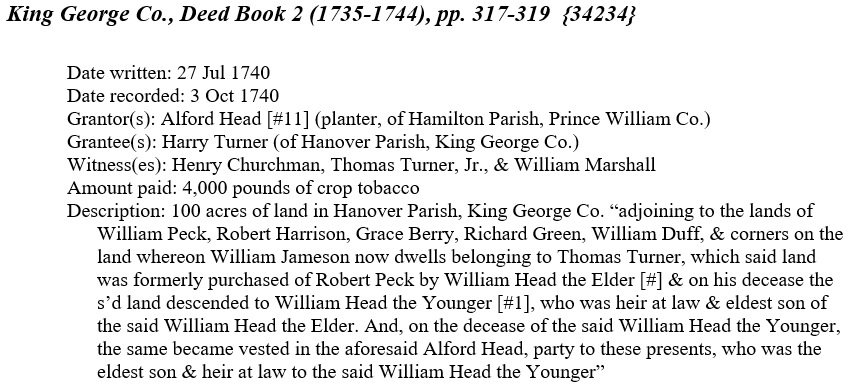
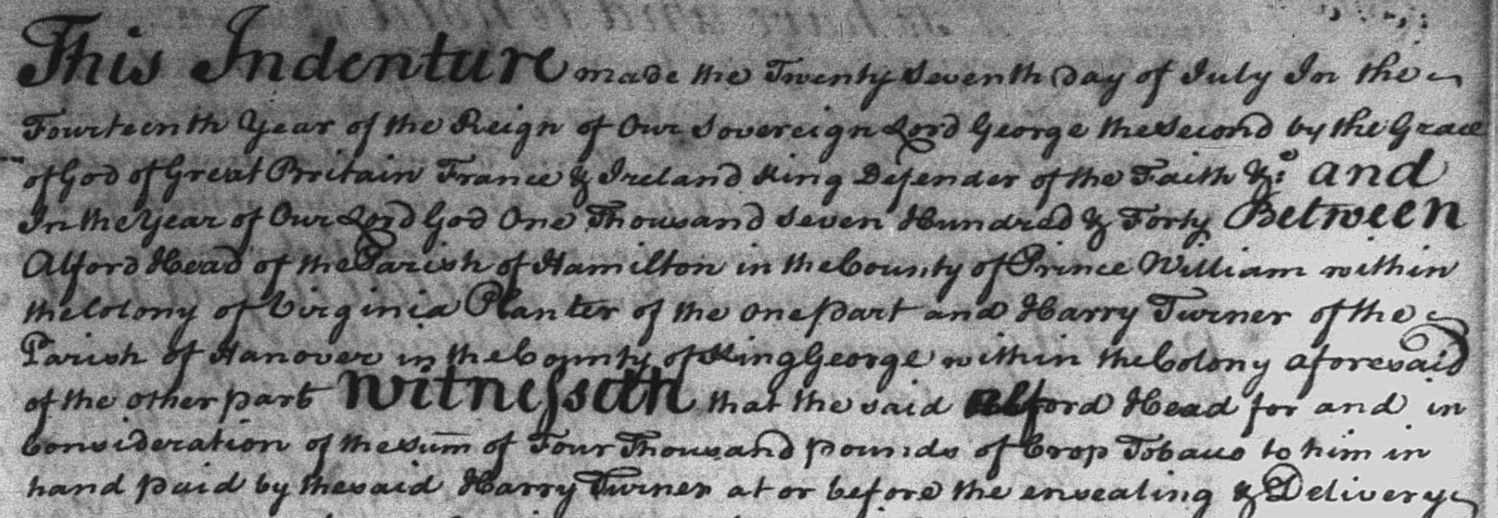
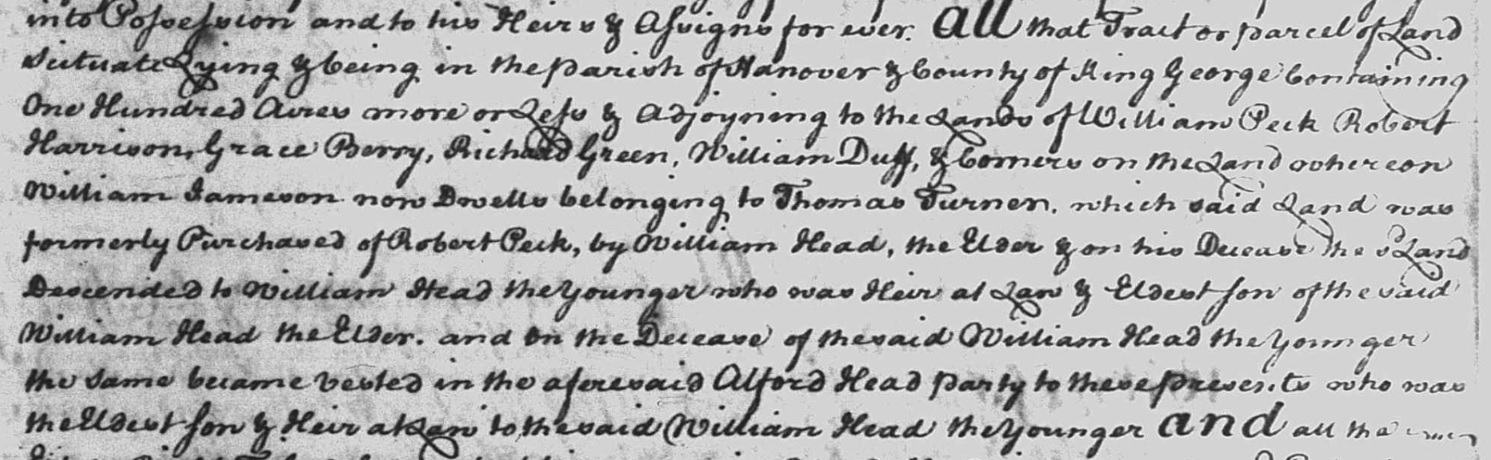
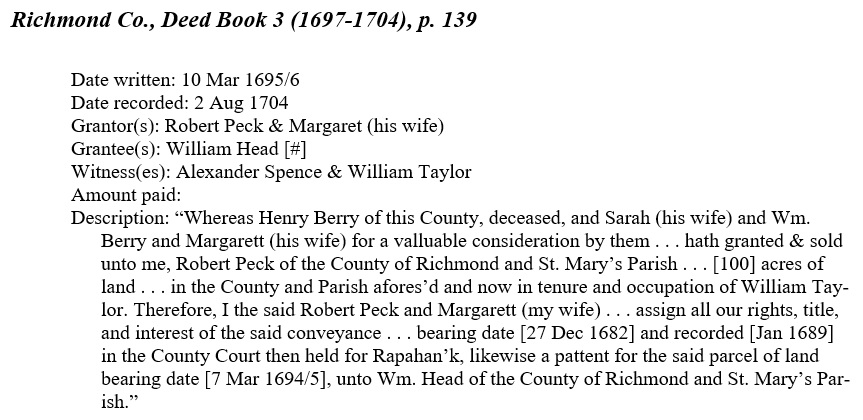
This 100 acres of land, located in Hanover Parish, King George County in 1740 was the same 100 acres that William Head (the Elder, immigrant) purchased from Robert Peck and his wife with a deed dated 10 March 1695/6 (recorded
2 August 1704 in Richmond County). At that time the land was located in St. Mary's Parish, Richmond County. (Old Rappahannock County was named Richmond County in 1692.) The Northern Neck counties underwent several changes in terms of
county formation and reconfiguration of borders during this time. With the formation of King George County (from Westmoreland and Richmond Counties) in 1720, Hanover Parish (of King George County) would be formed from St. Mary's Parish (of Richmond County).
It is a good assumption that both William Heads (Elder and Younger) lived on this land, as Court Minutes show that they resided at that time in what was then Richmond County.

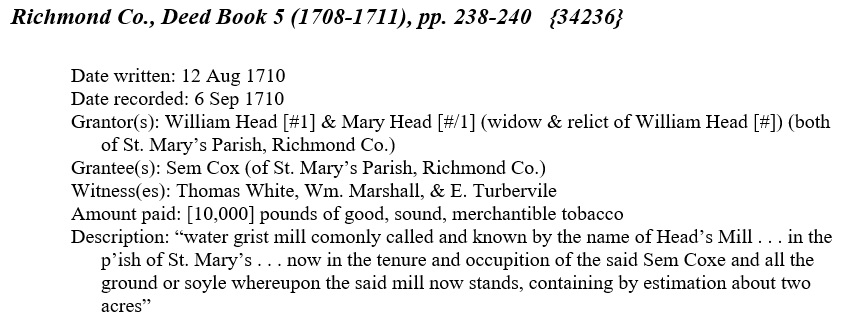
Knowing this allows us to identify the two William Heads whose deaths are recorded in Richmond County in the years 1710 and 1711. Assuming that the deaths occurred where they resided, we know that to be in the part of that county
that later became Hanover Parish in King George County (in 1720). The first evidence of the death of William Head (immigrant, the Elder) is a deed dated 12 August 1710 (recorded 6 September 1710 in Richmond County), in which
Mary Head, "the widow and relict of William Head, late of the p[ar]ish of St. Mary's", and William Head [#1, the Younger] sell the grist mill known by the name of Head's Mill. (This tells us that William Head the Elder was married at the
time of his death to Mary. It is not known when and where they were married, nor do we know if Mary was the mother of the William the Younger or the other sons of William the Elder. As discussed later in this page, there is evidence
of an earlier marriage of William the Elder.)

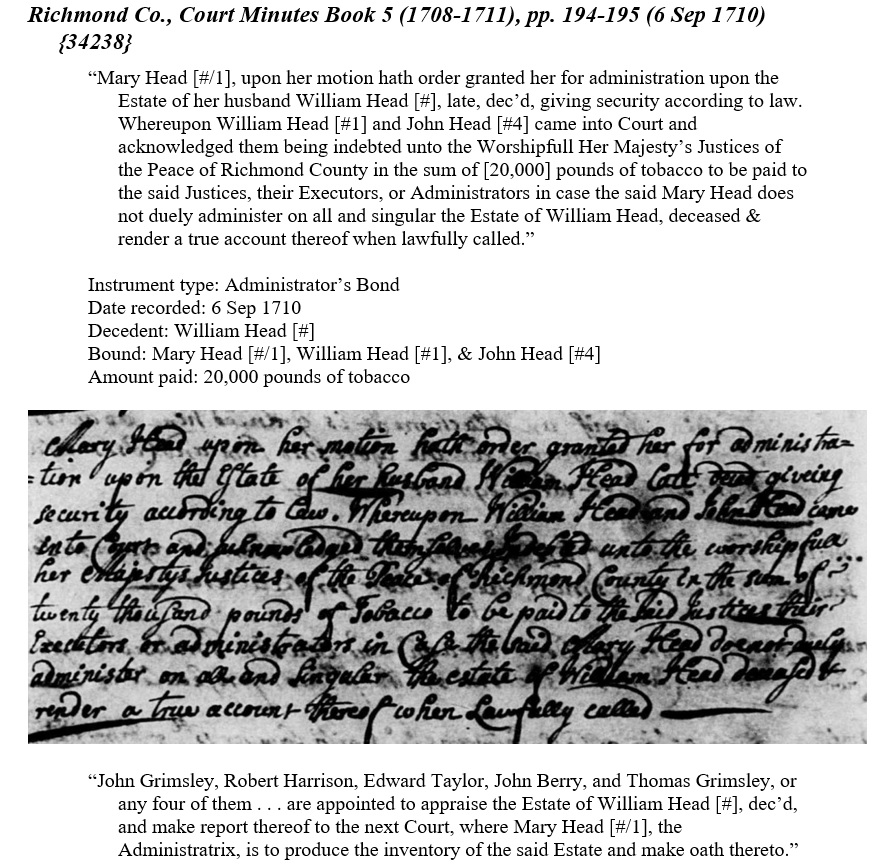
William Head the Elder died intestate (without a will). His widow Mary filed for Letters of Administration on 6 September 1710 in Richmond County. Posting bond with her were William Head [#1, the Younger] and John Head [#4], another son
of William the Elder. Several men in Richmond County were assigned to appraise the estate. The appraisal and listing of his property (filed in Richmond Co., Will Book 3 (1709-1717), pp. 24-25) make for interesting reading.
William Head [#1, the Younger] followed his father in death in 1711. William died intestate and his widow Elizabeth [#1/1] filed for Letters of Administration on 4 July 1711 in Richmond County. Since William the Younger
witnessed a deed on 3 Jan 1710/1, when can place the date of his death at sometime between then and the filing for Letters of Administration.
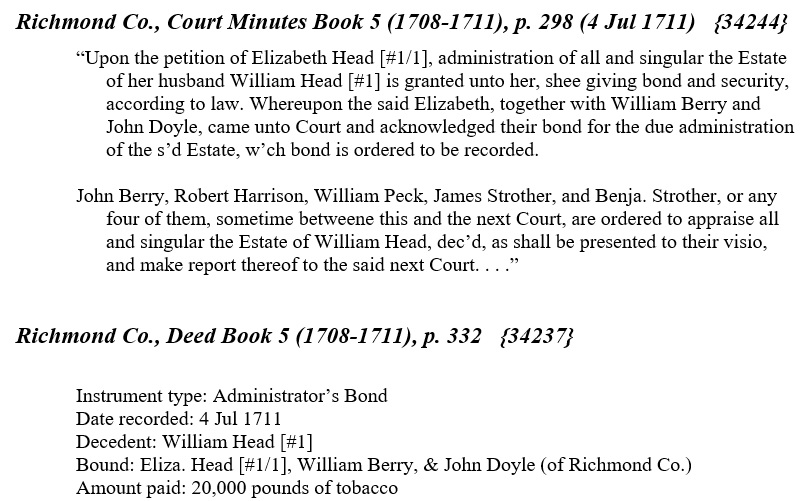

Records of Richmond County following the deaths of William Heads the Elder and Younger are instructive in that they mention several other family members, including Henry Head [#5] (the subject of Idress (Head) Alvord's book)
in this lawsuit filed against the heirs of William Head the Elder. See also my abstracts of the records of King George County starting in the 1720's, as they mention several of the sons of William Head the Younger, including Anthony Head [#12] (probably
William the Younger's second son, after Alford [#11]).
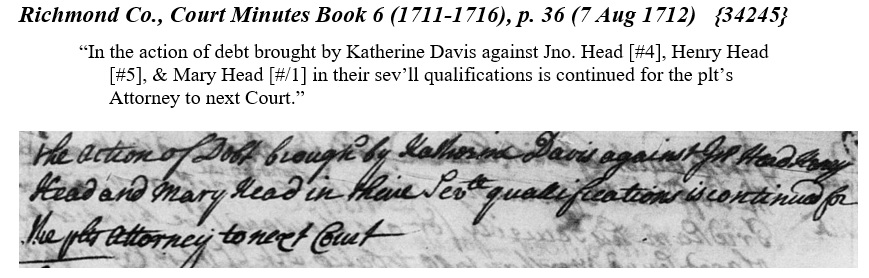
So, we now know that William Head the Elder (the immigrant) died around 1710 in Richmond County (later King George County), leaving a widow Mary and sons William [#1], John [#4], and Henry [#5]. Where was he born and how did he
get to Virginia, where did he live in the Northern Neck prior to his death, was he married to anyone else prior to Mary, and did he have any other children? The fragments of evidence in the records of the Northern Neck counties,
along with Y-chromosome DNA findings, can help us answer some of these questions.
One of the Y-chromosome DNA test results is that of a kit labeled "Ancestry.com 8", who appears to be a match with the descendants of William Head (the immigrant).
This kit is from a man whose Head ancestor came to America from England in 1910. His direct paternal lineage can be traced back to a Christopher Head, who was born in 1666 in a village named Corton, in historic Wiltshire County, England.
That makes Wiltshire County a likely candidate as the place where William Head the Elder lived prior to coming to Virginia in the 1600's. We need corroboration of this by recruiting more Head men for the Head DNA Project (whose direct
paternal lines remained in England), preferably with the 111-marker (Y-DNA111) or Big Y-700 tests. Hopefully we can find some more who are strong matches with our Head cluster in this project.
The configuration of the counties comprising Virginia's Northern Neck (between the Potomac and Rappahannock Rivers) is quite different today than what it looked like in the 1600's and 1700's. Familiarizing yourself
with these changes is important when researching families in this area. Northumberland County used to extend up the entire east side of the Northern Neck peninsula. In 1653, Westmoreland County
was formed from the northern part of Northumberland County. Stafford County was formed from the northern part of Westmoreland County in 1664 (on the east side of the line defining the watershed of the Potomac River, which ran approximately
down the middle of the peninsula). Directly to the west of Stafford and Westmoreland Counties was Rappahannock County (formed in 1656), from which Richmond County was formed in 1692. (The name Rappahannock County was then abolished
and a different Rappahannock County was formed in 1833 in another part of Virginia. The original Rappahannock County is often referred to as Old Rappahannock County.) Richmond County ran from the watershed line west to the
Rappahannock River. King George County was then formed in 1720 from the northern part of Richmond County and a portion of Westmoreland County. Prince William County was formed in 1727 from the northern parts of Stafford and
King George Counties. In 1777, things really changed when Stafford, King George, and Westmoreland Counties swapped land with each other to form the configuration we see today. Prior to that, Stafford County reached all the
way down the peninsula to Westmoreland County. (Keep that in mind when looking at where our Heads appeared in County Court records during this time. They didn't move long distances back and forth; the counties did.)
The first known appearance of a Head in the Northern Neck is this entry in the Court Minutes of Northumberland County on 5 September 1660, documenting a headright grant of 300 acres of land for transporting six persons into the
colony of Virginia, including a William Head.
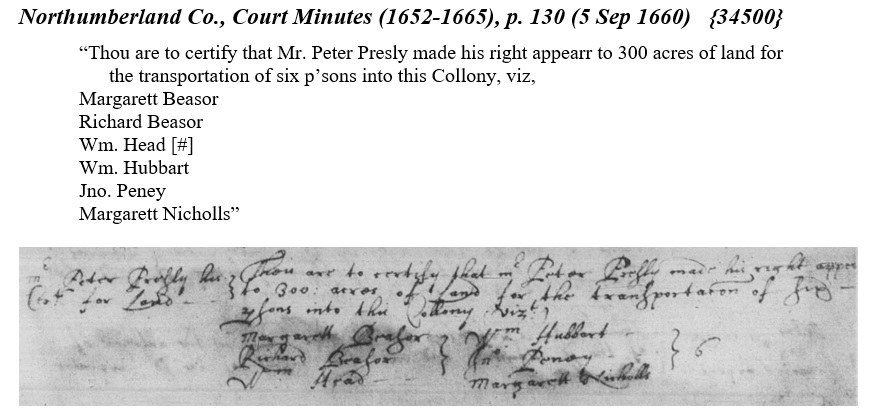
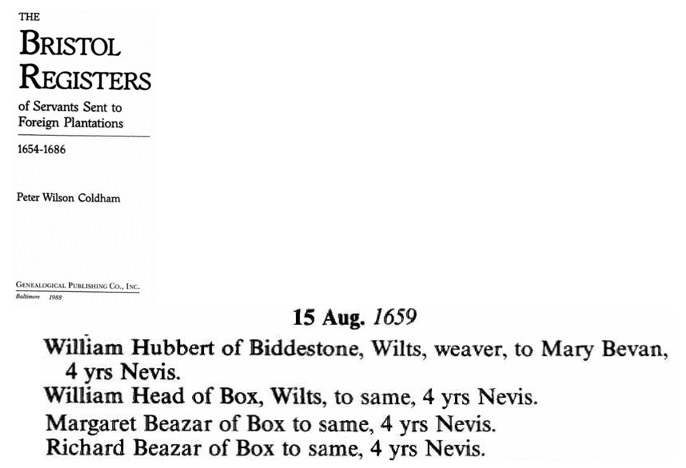
Four of these same persons appear to be on a register of servants sent from the English port of Bristol to the Caribbean island of Nevis on 15 Aug 1659, indentured by Mary Bevan. Were they subsequently sold by her to Peter Presly in Virginia?
This record indicates that they were obligated for four years of service as indentured servants. Was that same commitment carried over when they arrived at the Northern Neck? Since William Head came over by himself as an indentured servant,
he was probably young and unmarried. Can we find a matching candidate in the registers of his home parish of Box, located in Chippenham Hundred in historic Wiltshire County, England?
Images of the parish registers for Wiltshire County can be found at Ancestry.com (possibly requiring a subscription): https://www.ancestry.com/search/collections/61187/.
This collection includes the registers for the Parish of Box: https://www.ancestry.com/imageviewer/collections/61187/images/45582_1831109331_1051-00002.
The images are sharp, but much of the handwriting is quite challenging until you get used to it. Here is my abstract of some of the baptism, marriage, and burial entries in Box from the 1600's relating to those with the Head surname:
Parish Registers of Box, Wiltshire County, England.
There were two baptisms in Box (also spelled Boxe) for someone named William Head in the decades immediately preceding 1659. One, baptized 22 January 1653/4 (son of Anthony Head and his wife Rachel, of Kingsdown), was clearly too young to have come
over as an indentured servant in 1659. The other, baptized 26 December 1642 (son of Henry Head), appears to be a good fit (about the right age). Since our William Head named a son Henry, that is encouraging. Looking at the names
of the other Heads in this parish register, what struck me was the number of occurrences of the name Anthony Head. Other male names (like William, George, Henry, Richard, and John) were quite common at that time in both
England and its colonies in America, but Anthony was not that common. We see the name Anthony Head [#12] for one of the older sons of William Head [#1] the Younger, a younger brother to Alford [#11]. Anthony named one of his
own sons Anthony [#122]. Another son of William Head (the immigrant), Richard Head [#2] (whom we will discuss a bit later), had a son named Anthony [#21], as well.
Much more work needs to be done with the primary documentary sources of Box (parish registers, probates records, etc.) to construct the Head family group. It would be great to find something documenting the indentured servitude
of William Head and the others from that parish who were sent to St. Nevis and then to Virginia in 1659-1660. There are Heads still living in Box today: http://www.boxpeopleandplaces.co.uk/head-and-chandler-families.html.
Would some of those men (with the Head surname) be willing to join the Head DNA Project and order a Y-chromosome DNA test kit? Did any of William Head's siblings or close cousins also come to America in colonial times?
Now, back to Virginia. The next mention of a Head in Northumberland County is the appearance of Jane Head as a witness to a lengthy will of Robert Walton (of Stafford County), written 14 January 1669/70 and proved 19 July 1671.
Who was she? Jane appears to have been the widow of John
Chambers (of Northumberland County), who died between 1652 and 1655. Jane would have been a bit older than the immigrant William Head (who was born around 1642), but perhaps she was his first wife and the mother of some of
his sons. No more is known about Jane. There will be later records showing a connection between the Chambers and Head families.
Francis Lewis (of Westmoreland County) left a will written 24 August 1671, proved 31 January 1671/2 & 28 Feb 1671/2 in Westmoreland County. One of the Executors was his "well beloved friende" William Head. In this will,
it states "I give & bequeath unto John Moone one cow of fowre yeare old called Spott and heifer of two yeare old called Sall [?]. . . . I give & bequeath unto John Moone [170] acres of land, being part of the said devident of land whereon William Lyppett now liveth. . . .
My will & desire that Wm. Head doe live and abide on my land, and he the said William Webb [Head] to take John Moone into his care untill he shall come unto the age of [17] yeares and to use him well but to keepe him to work."
This is the first mention of William Head after his arrival in Virginia in 1660 and places him in Westmoreland County as early as 1672.



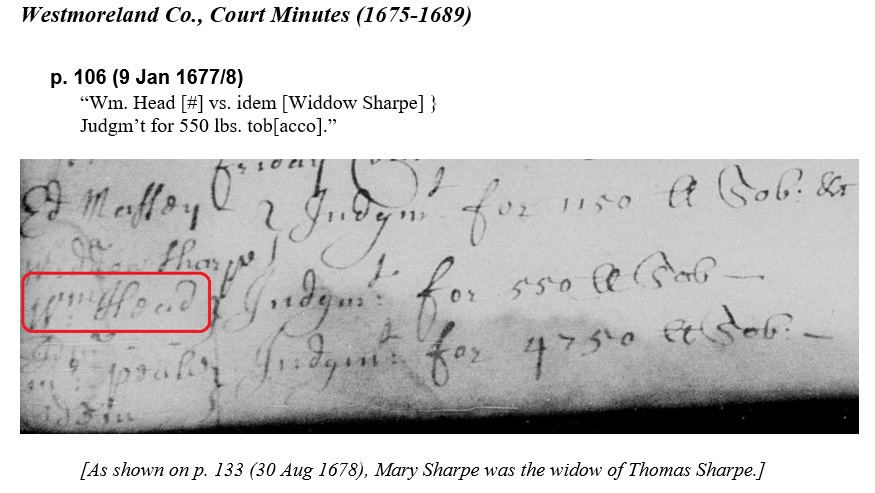
William Head appeared again in Westmoreland County on 9 January 1677/8 when he won a judgment for 550 pounds of tobacco (then the official currency) in a court case against Mary Sharpe, widow of Thomas Sharpe.
On 7 April 1690, William Head appeared in Stafford County court as a witness to a will written by Robert King (of Stafford County).
William Head was one of several men appointed to appraise the estate.
We have already seen that William Head purchased 100 acres of land in what was then Richmond County on 10 March 1695/6 (from Robert Peck and his wife Margaret). Based on descriptions of adjoining land,
this property was located on or near Gingoteaque Creek, a tributary of the Rappahannock River.
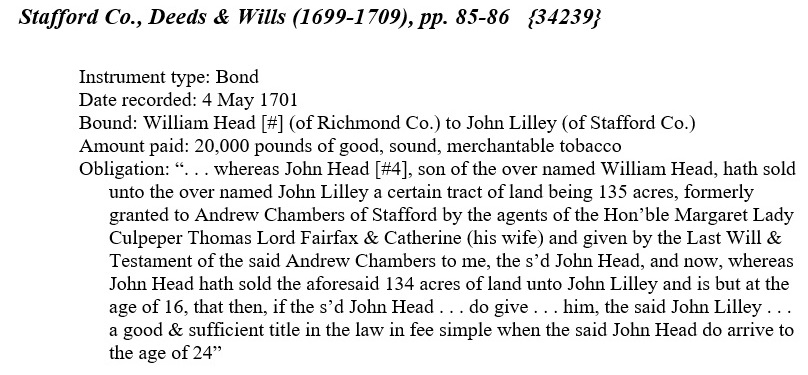
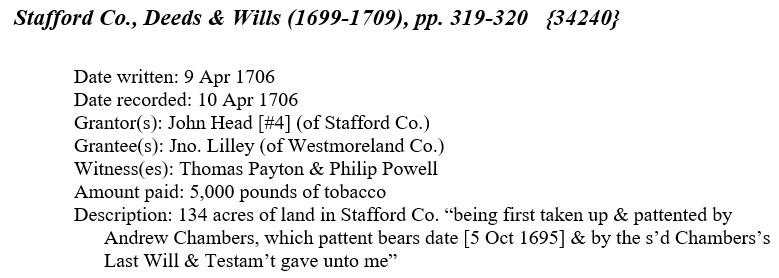
Andrew Chambers (of Stafford County) died sometime in the late 1690's and left 134 (or 135) acres of land to John Head [#4], a son of William Head the Elder. What was the relationship of Andrew Chambers to the Head
family and why did he leave this property to a minor? Could Andrew have been a stepson of William Head the Elder (by his wife Jane's prior marriage to John Chambers)? The bond recorded in Stafford County on 4 May 1701 shows that John Head was 16 years of age, placing the
year of his birth at about 1685. John sold the land to John Lilley in 1706 when he reached the legal age of 21 years.

Aside from a few entries mentioning her after the death of her husband William Head the Elder (the immigrant), nothing more is known about his widow Mary. And what became of Jane (possibly his first wife)? No mention is made of any
daughters. Surely he had some. William Head [#1] the Younger had several sons who expanded to the newer counties of Virginia that were spawned off the Northern Neck counties in the 1700's and many of the Heads in America can trace
their direct paternal lineage to him. The same can be said of Henry Head [#5], who married Frances Spence (a daughter of Alexander Spence and Elizabeth Browne). Nothing further is known about the son John [#4].
Letters of Administration were granted on 7 March 1748/9 in Spotsylvania County, Virginia to Betty Head, widow of James Head [#3]. Nothing further is known about them. Henry Head [#5] was also living in Spotsylvania County
at this time, so it is assumed that James Head was his brother, but that isn't corroborated.
In the early 1700's, Richard Head [#2] and several sons were living in the Virginia/North Carolina border counties (southeastern Virginia and northeastern North Carolina). By the late 1760's, they were living in
Granville County, North Carolina, intermingled with the families of some of the grandsons of William Head [#1] the Younger. There is no documentary evidence linking them to the Heads of the Northern Neck, but Y-chromosome DNA testing
of several of the direct male descendants of Richard Head show that they are of the same Head family. So, I've assigned Richard to this family as one of the sons of William Head the Elder. More work needs to be done to corroborate
that and show when he left the Northern Neck.
Many of the subsequent generations of this Head family left Virginia after the end of the American Revolution and settled in the states of North Carolina, South Carolina, Georgia, Tennessee, and Kentucky. Very few, if any, remained
in the Northern Neck.
Descendant Listings
Descendants of William Head through five generations
Here is the GEDcom file of descendants through five generations: GED-Head-0-5.ged.
I have uploaded this as Public Member Tree to Ancestry.com, as well.
Explanation of Format of Descendant Listings
Documentary Sources
England Notes (Parish Registers, etc.):
Wiltshire County
USA Federal Censuses:
1790
1800
1810
1820
1830
1840
1850
USA Notes (Vital Records, Wills, Deeds, Tax Lists, Cemeteries, etc.):
Alabama
Georgia
Kentucky
Missouri
North Carolina
South Carolina
Tennessee
Virginia
USA American Revolution Pension Files:
R.4814 - James Head [#1321]
R.4815 - Robert Head [#1215]
S.13365 - Richard Head [#231]
S.1463 - Benjamin Head [#523]
S.6995 - John Stromatt Head [#1511]
DNA Research
Head DNA Project
A new tool in genealogical research is the use of genetic markers in DNA to establish family relationships. See Y Chromosome DNA Testing. The Y-chromosome is passed down from father to son to grandson to great-grandson, etc. along the male line (as are surnames in many modern western societies). Occasionally, due to random mutations, one or more of the genetic markers may change in an individual and be passed down to his son that way. Standard tests are available (based on a cheek swab) to identify 37, 111, or more markers on the Y-chromosome. (The more the markers, the more precise the identification; 37 or more markers should be tested, in order to be useful for genealogical purposes. Older tests at 12 and 25 markers are not useful and should be upgraded.) All direct male descendants of William Head would have a very similar, if not identical, set of markers (or haplotype). Someone with a surname of Head (or some variation), whether or not they had done in-depth genealogical research, could compare their haplotype to known William Head direct male descendants see if they were likely to be a direct male descendant of William Head. Likewise, the William Head haplotype could be compared to haplotypes of other families to see if these families were closely related. The Family Tree DNA testing service is one of the most well-known and best suited for Y-DNA testing. If anyone is interested, please contact me by e-mail. The tests can be ordered from Family Tree DNA as a part of the Head DNA Project. In this project, please view both the Results and Patriarchs pages (https://www.familytreedna.com/groups/Head/about/results) to see how this Head family compares to others of the same surname.
Head Y-DNA Results
Patriarchs of Head Y-DNA Test Participants
To help defray the cost of the testing, there is a Head DNA Project fund that will allow those of us without the Head Y-chromosome (such as females born with the maiden name of Head) to jointly share in the cost of this project. If those interested in this avenue of research can contribute a little from time to time, it will greatly help to increase the level of participation by direct male descendants with the "right" DNA. If you would like to take advantage of the fund for your test, let the Project Administrator know. Those of us without the Head Y-DNA chromosome may help others out by contributing.
The Y-chromosome DNA haplogroup of William Head, I1a2a1a1c (M253+,Z61+,FGC23806+,FTA88488+), makes it is easy to identify if someone with the Head surname is of this same
family, as all men of this family who are direct male descendants would be of a matching haplogroup and test positive for these markers. According to this article, https://discover.familytreedna.com/y-dna/I-FGC23806/story, the marker I-FGC23806 is most prevalent in men
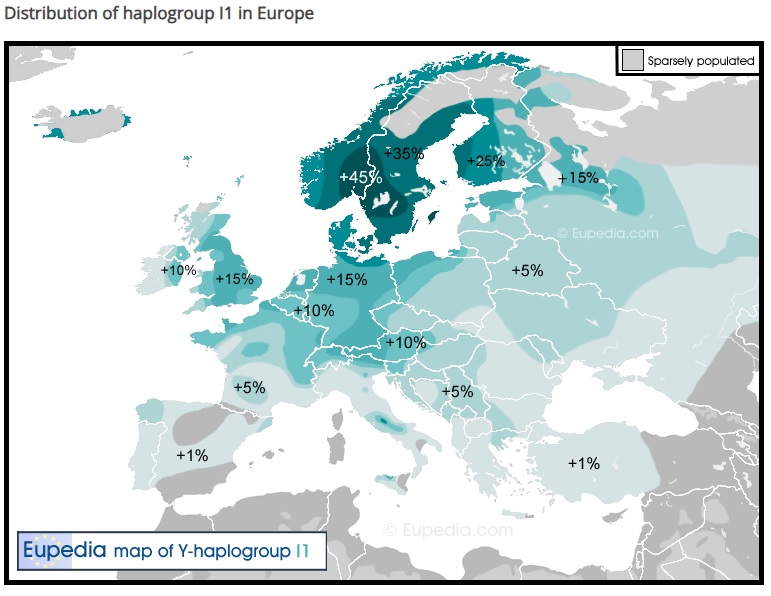
whose ancestry traces back to Finland and England, indicating a Nordic origin for this direct paternal line. The parent haplogroup family, I1, is most
heavily concentrated in Scandinavia and far northern Europe. Did William Head's direct paternal line arrive in Great Britain through the Viking invasions?
Maybe some future Y-DNA matches might reveal a connection with one of the Nordic countries in historical timeframes and shed some light on this question. Notice that the town of Chippenham is only about 10 km (6.2 miles)
away from the village of Box in historic Wiltshire County, England. The Battle of Chippenham, was fought there in January 878 CE between a Viking army led by Guthrum and an Anglo-Saxon army led by Alfred the Great.
The results of the Y-chromosome DNA tests clearly show that the test participants, males mostly with the Head surname, belong to a number of different (unrelated) Head families. In the Results spreadsheet, the various
Head families have been arranged into clusters, with the clusters each indicated by a unique background highlighted color. This is very helpful to those who are researching their Head genealogy, as it allows you to focus
your research on the relevant family (highlighted cluster), while ignoring the rest. The family to which our immigrant ancestor William Head (of Box Parish, Wiltshire County, England) belongs is indicated in the spreadsheet
by a bright yellow highlighted background (sample below). The first two columns (from left to right) are kit number and earliest confirmed direct paternal ancestor. In the next column, for those who have documentary evidence showing their descent
from the immigrant William Head, the Descendant ID of their branch is shown. Otherwise, you'll see a comment. Some of these kits were submitted by men with a surname other than Head, but they clearly belong to this Head family, as shown by
their Y-chromosome DNA results. The next column shows the haplogroup, with the haplotype (Short Tandem Repeat, or STR, values) to the right of that (up to 111 of them). A "+" in the rightmost column shows that the test
participant has done the Big Y-700 test.
In the haplogroup column, the notation "I1 (M253)" (in red) means that the haplogroup has been estimated to be positive for the Single Nucleotide Polymorphism, or SNP, known by the name of I-M253, based on the STR values.
This SNP (I-M253) places our Head direct paternal line within the I haplogroup tree of humanity, as defined by the International Society of Genetic Genealogy (ISOGG), this SNP being very old,
near the base of the I branch. For a number of these kits, FamilyTreeDNA has done further testing for much more recent SNP's (those further out on the I branch), as indicated by the notations in green. The notation "I1a2a1a1c (M253+,FGC23806+,FTA88488+)" means
that this kit tested positive for SNP's called I-M253, I-FGC23806, and I-FTA88488 (as well as dozens of others). I-FTA88488 is the most recent known SNP for this branch (furthest out on the tree). All other positive SNP's are
upstream of it. Some of the kits in this family cluster don't appear with the I-FTA88488 SNP (in green), which just means that they haven't been tested for it (yet). If a test were ordered for that SNP, it would certainly test positive,
as these kits' haplotypes (STR values) show such a close match to the others. As more of the kits are tested up to 111 markers and beyond (Big Y-700), the haplotype values (STR's) will likely allow us to determine where these kits fit within the descendants of
the immigrant William Head. Another focus of the Head DNA Project is testing of men with the Head surname whose families remained in England, such as the kit labeled "Ancestry.com 8". That will allow us to confirm the connection to historic Wiltshire County and the
relationship of the immigrant William Head to other Heads in that part of England.

This DNA project is open to other Head families with British heritage, as well as African-Americans whose ancestors took the Head surname when they were emancipated.
It will establish if there is any relationship
between these families and ours, perhaps prior to William Head's generation. In addition, it will help differentiate
between the various Head families in the USA and elsewhere, especially where the documentary evidence is lacking.
It is especially important to have Y-chromosome DNA testing done for those Head males (with the surname) whose family
remained in the British Isles, as it will help to establish the possible points of origin for the surname and provide
clues as to where Head ancestors may have lived before they immigrated to America and elsewhere.
Acknowledgements
I owe a great debt to my maternal grandfather Demus C. Kizer, who in 1968 sparked my interest in
genealogy by sharing his stories about growing up in rural Arkansas during the early 1900s. I was 11 years
old at the time, and was fascinated hearing about all of the different families and how they were connected.
I immediately started writing to my relatives, sent away for census records and Civil War pension
files, and have kept going ever since. It is through his wife (my maternal grandmother) Cora Ruth (Shambarger) Kizer that I trace my lineage to the immigrant William Head (my 8th-great-grandfather).
In the course of my research on my Head family, I became aware of significant works that had been published in earlier years by Idress (Head) Alvord, Henry Oswald "H. O." Head, and others. More recently I met and collaborated with dedicated Head
researchers like John Harris Watts, James R. Landrum, John C. Head, James E. Mitchell, Thomas Barton Nash, and others too numerous to name. This Head web page would not have been possible without the contribution of these and other researchers over many
years. During my 56+ years of research, I have tried to carefully document the primary sources of each piece of information
in my database in order to validate the extensive research done by myself and many others.
I continue to be amazed and gratified at the sense of teamwork displayed by other genealogists I have met. Hopefully this
compilation will help others now and in the future to carry on the work that has been done
so far.
If you would like to comment on any information contained within, or wish to correspond with me about this family, please send me an e-mail
message at: contact@arslanmb.org. Additions and corrections are greatly appreciated. I am especially
interested in receiving information obtained from primary sources (parish registers, census listings, Bibles, cemeteries, vital records, probate and land records,
etc.) and photographs and digital images relating to this branch of the Head family so that I can incorporate them into this page. Also, I would
like to provide links to other pages on the Internet that deal with Head genealogy.
Mark B. Arslan
Last
updated on 10 June 2024